
Trauma bonding is defined as a strong emotional attachment to an abuser, formed through repeated cycles of harm and intermittent kindness. The term was first developed by psychologists Donald G. Dutton and Susan L. Painter, who identified that power imbalance and intermittent reinforcement create bonds that are more persistent than those formed through consistent abuse alone. This is not a formal diagnosis, but it is a well-recognised psychological pattern with serious consequences for mental health, self-esteem, and future relationships. If you have ever felt inexplicably loyal to someone who hurt you, this pattern may explain why.
What causes trauma bonding and how does the cycle work?
Trauma bonding forms when two conditions exist together: a significant power imbalance and unpredictable alternation between cruelty and warmth. The unpredictability is the engine. When kindness arrives without warning after a period of harm, the brain treats it as a reward, releasing dopamine in a pattern that mirrors addiction.
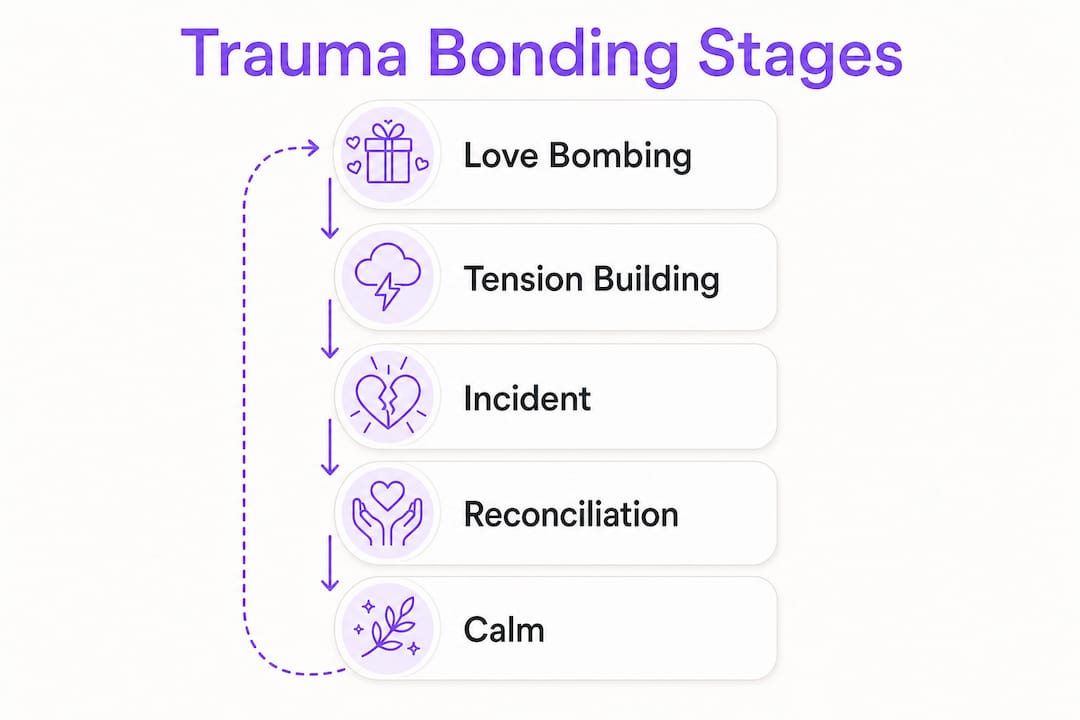
Research identifies a seven-stage progression that most trauma bonds follow. Understanding these stages helps you see the pattern rather than just the pain.
- Love bombing. Intense affection, attention, and flattery flood the early relationship, creating a powerful emotional high.
- Trust and dependency. The victim begins to rely on the abuser for emotional validation and a sense of security.
- Criticism. Subtle put-downs and fault-finding begin, eroding self-worth while the victim works harder to regain approval.
- Manipulation and gaslighting. Reality is distorted. The victim begins to doubt their own perceptions and memory.
- Resignation. Exhaustion sets in. The victim stops resisting and accepts the abuser's version of events.
- Emotional addiction. The cycle of harm and relief becomes the emotional baseline. The victim craves the "good" periods intensely.
- Loss of self. Identity and autonomy erode. The abuser becomes the primary reference point for the victim's sense of worth.
| Stage | Key characteristic |
|---|---|
| Love bombing | Overwhelming affection creates initial dependency |
| Criticism | Self-worth is gradually dismantled |
| Gaslighting | Victim's perception of reality is distorted |
| Resignation | Resistance collapses; compliance increases |
| Emotional addiction | Intermittent kindness becomes a craved reward |
Healthy attachment is built on consistency, mutual respect, and safety. Traumatic relationships operate on the opposite logic: safety is unpredictable, and the relationship itself becomes the source of both the wound and the relief.

Pro Tip: Victims feel loyalty despite harm because the nervous system has been conditioned to associate the abuser with relief, not just pain. This is not weakness. It is a predictable neurological response to intermittent reinforcement.
What are the signs of trauma bonding to watch for?
The signs of trauma bonding are often invisible from the inside. Emotional confusion is the defining feature. Victims simultaneously feel love, fear, hope, and despair, sometimes within the same hour. This confusion makes it nearly impossible to assess the relationship clearly.
Common behavioural and emotional indicators include:
- Difficulty leaving even when you recognise the relationship is harmful
- Defending or making excuses for the abuser's behaviour to others
- Blaming yourself for the abuse or believing you provoked it
- Feeling intense anxiety or panic at the thought of separation
- Returning repeatedly after leaving, often multiple times
- Feeling numb, detached, or disconnected from your own emotions
- Prioritising the abuser's needs and moods above your own wellbeing
The neurobiological dimension makes these signs harder to interpret. Relational trauma rewires the nervous system so that the abuser becomes encoded as a source of safety, not danger. The brain sends "approach" signals where logic would suggest "retreat." This is why survivors often describe feeling pulled back even when they know the relationship is destructive.
Pro Tip: Self-blame is one of the most common and most damaging misconceptions about trauma bonding. The bond forms because of how the abuser structured the relationship, not because of any flaw in the victim. Recognising this distinction is the first step toward releasing shame.
How does trauma bonding affect mental health and future relationships?
The mental health consequences of traumatic relationships extend well beyond the relationship itself. Victims commonly experience negative self-image, chronic low self-esteem, depression, anxiety, and dissociation. These effects persist long after the relationship ends because the nervous system remains in a state of alert.
"Relationship trauma is a clinical phenomenon involving nervous system rewiring, shattering the victim's assumptive world and sense of safety. Recovery requires more than insight. It requires rebuilding the body's capacity to feel safe." Source: Relational trauma: Signs & healing
The biological dimension is significant. Trauma bonding is a survival strategy where the nervous system prioritises the abuser as a safety source when escape feels impossible. This creates addiction-like patterns that are physiological, not merely emotional. Withdrawal from the bond can produce anxiety, depression, insomnia, and intense cravings for intermittent kindness, mirroring the experience of substance detox.
Cognitive distortions such as catastrophising and all-or-nothing thinking maintain emotional dependency long after the relationship ends. Survivors often believe their life cannot continue without the abuser. This is not a reflection of love. It is a distortion produced by prolonged psychological manipulation.
Future relationships are also affected. Repetition compulsion, a pattern identified in trauma psychology, leads survivors to unconsciously seek out familiar relational dynamics. This can mean choosing partners who replicate the same cycles, not because the survivor wants harm, but because the nervous system recognises the pattern as "normal."
| Mental health impact | What it looks like in daily life |
|---|---|
| Chronic low self-esteem | Difficulty making decisions; constant self-doubt |
| Depression and anxiety | Persistent low mood; hypervigilance in relationships |
| Dissociation | Feeling detached from emotions or sense of self |
| Repetition compulsion | Repeatedly choosing harmful relational dynamics |
| Withdrawal symptoms | Insomnia, cravings, and emotional dysregulation after leaving |
What are the proven strategies for breaking trauma bonds?
Breaking a trauma bond requires more than willpower or intellectual understanding. Effective recovery uses a multi-modal approach combining trauma-informed therapy, nervous system regulation, and the deliberate building of safe support networks.
The most evidence-supported steps are:
- Seek trauma-informed therapy. Cognitive Behavioural Therapy (CBT) addresses distorted thinking patterns. Somatic therapy works with the body's stored trauma responses. Narrative therapy helps survivors reconstruct a coherent sense of self and story.
- Regulate the nervous system. Purely cognitive approaches often fall short because trauma bonding involves primitive brain circuits. Breathwork, grounding exercises, and mindfulness practices calm the physiological alarm system before cognitive work can take hold.
- Create a safety plan. Identify trusted people, safe spaces, and practical steps for leaving or maintaining distance. A safety plan reduces the decision-making burden during moments of high emotional distress.
- Build a support network. Isolation is a hallmark of abusive relationships. Reconnecting with trusted friends, family, or peer support groups counters the abuser's influence and provides external reality checks.
- Manage withdrawal actively. Expect discomfort. Anxiety, grief, and cravings for contact are normal withdrawal responses. Journaling, structured routines, and professional support reduce their intensity.
- Set and hold boundaries. Boundaries are not punishments. They are the architecture of a safer life. Practising boundary-setting in low-stakes situations builds the capacity to hold them under pressure.
Narcissistic abuse recovery, in particular, benefits from combining body-focused and cognitive therapies. The abuser's tactics often target both the mind and the body's sense of safety, so healing must address both levels simultaneously.
Pro Tip: Combining somatic and cognitive therapies works best because trauma bonding bypasses rational thought. The body needs to learn safety before the mind can fully process what happened. Start with nervous system regulation, then layer in cognitive work.
How does trauma bonding differ from healthy attachment?
Trauma bonding and healthy attachment can feel similar from the inside, particularly in the early stages. Both involve strong emotional connection and a desire for closeness. The difference lies in the structure of the relationship and the source of the bond.
Healthy attachment is built on consistent safety, mutual respect, and the freedom to express needs without fear of punishment. Trauma bonding is anchored in abuse cycles. The connection intensifies not despite the harm, but because of it. The relief that follows abuse becomes the emotional glue.
Codependency overlaps with trauma bonding but is distinct. Codependency involves an excessive reliance on another person for emotional regulation, often without overt abuse. Trauma bonding specifically requires an abuse dynamic, including psychological manipulation effects such as gaslighting, coercive control, or physical harm.
| Feature | Healthy attachment | Trauma bonding | Codependency |
|---|---|---|---|
| Source of bond | Consistent safety and care | Cycles of harm and relief | Emotional over-reliance |
| Power dynamic | Balanced | Significant imbalance | Often imbalanced |
| Leaving the relationship | Possible without crisis | Feels impossible; withdrawal symptoms | Difficult but not physiologically addictive |
| Self-worth | Maintained or enhanced | Eroded over time | Often low but not from abuse |
Trauma bonds also form outside romantic relationships. Family systems, cults, and certain friendships can produce the same cycle of harm and intermittent kindness, creating the same neurological and psychological dependency.
Key takeaways
Trauma bonding is a neurologically driven attachment pattern formed through abuse cycles, and breaking it requires both body-focused and cognitive therapeutic approaches.
| Point | Details |
|---|---|
| Trauma bonding is not a choice | It forms through neurological conditioning, not weakness or lack of love. |
| The cycle has seven stages | Recognising the stages helps survivors see the pattern and name what happened. |
| Mental health effects are lasting | Depression, dissociation, and repetition compulsion persist beyond the relationship. |
| Recovery requires multi-modal therapy | CBT alone is insufficient; somatic and mindfulness approaches address primitive brain circuits. |
| Withdrawal is real and physical | Expect anxiety and cravings after leaving; treat them as physiological, not emotional failure. |
What I have learned about trauma bonds after years of working with men in painful relationships
The most common thing I hear from men who come to me stuck in a pattern they cannot explain is some version of: "I know it was bad, but I cannot stop thinking about them." That sentence is not confusion. It is a description of a nervous system that has been rewired.
What strikes me most is how rarely survivors give themselves credit for surviving something genuinely difficult. Trauma bonding is not a sign of weakness. It is a sign that the brain did exactly what brains do under sustained threat: it adapted. The problem is that the adaptation outlasts the threat.
I have also noticed that purely intellectual understanding rarely produces change on its own. Men can recite every stage of the cycle and still feel the pull. The work that actually shifts things happens in the body first. When someone learns to feel safe in their own nervous system, the cognitive pieces fall into place far more readily.
The other thing I would say plainly: recovery is not linear. There will be days when the pull feels as strong as ever. That does not mean the work is failing. It means the nervous system is still recalibrating. Patience with that process is not passive. It is the work.
If you are reading this and recognising your own story, that recognition matters. It is not just reassuring. It is the first step toward doing something about it.
— Will
Coaching support for men navigating relational trauma
Recognising a trauma bond is one thing. Knowing what to do next is another. Lifebywill works with men who are ready to understand their relationship patterns and build something different.
Through one-to-one coaching and couples coaching, Lifebywill offers a confidential space to work through the emotional dependency, self-blame, and nervous system dysregulation that trauma bonds leave behind. The Reset programme is designed specifically for gay men over 40 who keep finding themselves in the same painful cycles and are ready to break them. Sessions are weekly, personalised, and grounded in real psychological understanding, not generic advice. If you are ready to work with someone who takes this seriously, Lifebywill is the place to start.
FAQ
What is trauma bonding?
Trauma bonding is a psychological pattern where a person forms a strong emotional attachment to an abuser through repeated cycles of harm and intermittent kindness. It is not a formal diagnosis but a recognised response to power imbalance and unpredictable reinforcement.
How do I know if I am trauma bonded?
Key signs include difficulty leaving despite recognising the harm, defending the abuser to others, intense anxiety at the thought of separation, and returning repeatedly after leaving. These responses reflect nervous system conditioning, not personal weakness.
Why is trauma bonding so hard to break?
Trauma bonding involves primitive brain circuits that encode the abuser as a source of safety. Withdrawal produces physical symptoms including anxiety, insomnia, and cravings, making the process comparable to recovering from substance dependency.
Is trauma bonding the same as love?
Trauma bonding is not the same as love, though it can feel identical from the inside. Healthy love is built on consistent safety and mutual respect. Trauma bonding intensifies through cycles of harm and relief, creating a neurological dependency rather than genuine connection.
Can therapy help break a trauma bond?
Yes. The most effective approach combines cognitive behavioural therapy with somatic and mindfulness-based methods. Purely cognitive therapy often falls short because trauma bonding bypasses rational thought and requires nervous system regulation alongside cognitive work.